This Black History Month, we have licensed four of artist Steve A. Prince’s social justice artworks to feature. We will post one artwork each Sunday, with questions and prompts for you to do Visio Divina, or “sacred seeing,” an ancient form of Christian prayer in which we allow our hearts and imaginations to enter into the image to see what God might have to say to us.
Meditate + Reflect
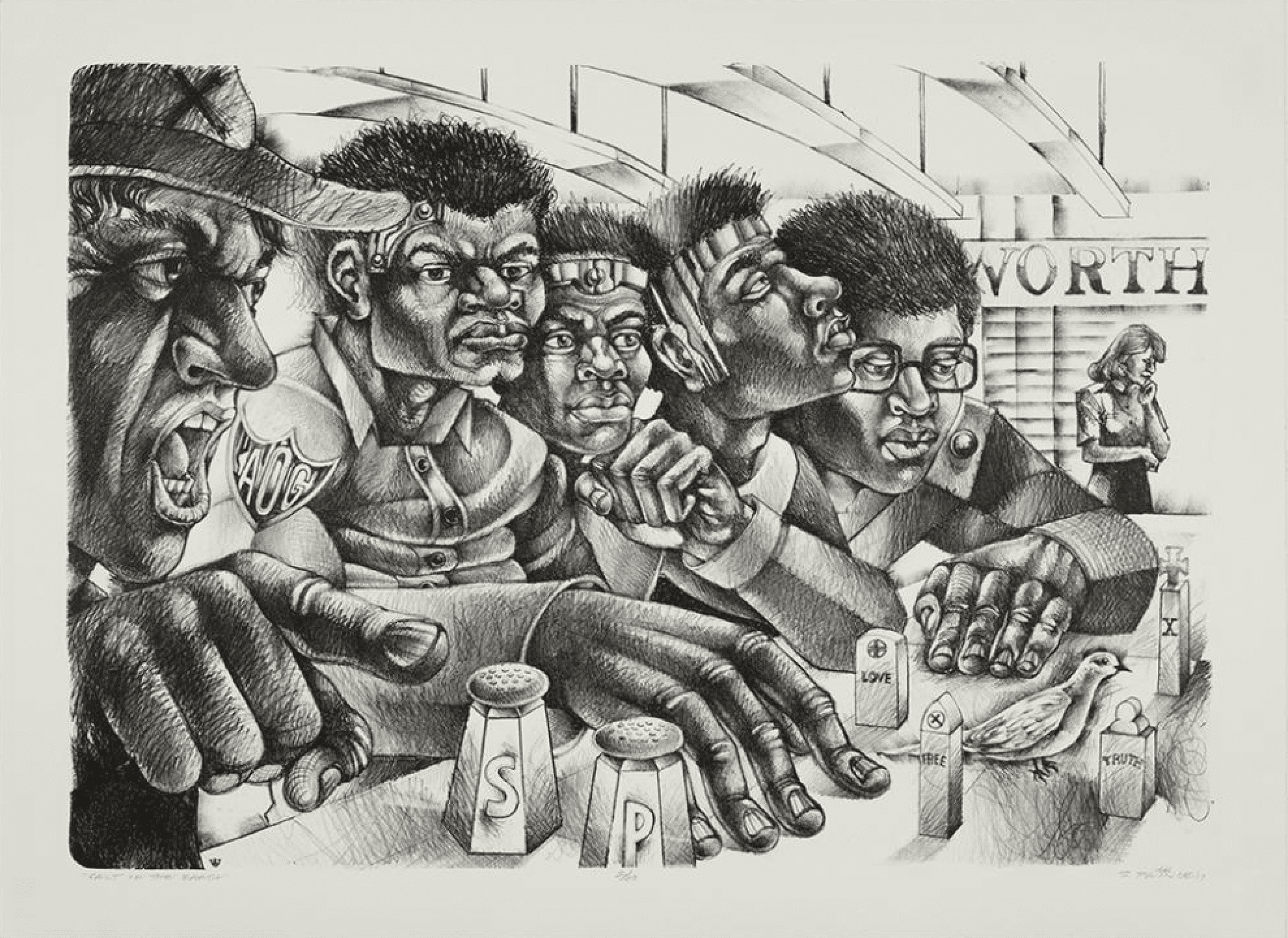
“Salt of the Earth,” Lithograph on Paper, 26″ x 35″ 2017
 Description from Steve:
On February 1, 1960, four African American men from North Carolina A&T staged a lunch counter sit-in at a local Woolworth. It began a protest against the denial of African Americans to have equal access to the establishment.
The title “Salt of the Earth” is derived from Matthew 5:13-16, that proclaims we are supposed to be the salt of the earth. If the salt has lost its flavor/savor, then we are useless. In Biblical times, salt was used a a preservative. So in my work, I use the idea of salt to represent that we are supposed to be preservers of truth and justice. Salt also was currency, used in burial practices, and one of the world’s most important and plenteous spices.
We, too, are valuable, plenteous, and important. The Greensboro Four were college students who pushed beyond the boundaries of book education and used their bodies to insert themselves into history as preservers of truth and justice. The Greensboro Four sparked a nation to look deeply in the mirror. Frankly, they affected the economy very much like the resistance that Rosa Parks catalyzed in Montgomery.
Unfortunately, their acts of bravery did not completely soften the hearts of our nation, because we are continually fighting battles that we thought were won. There are a lot of stains in the fabric of our nation that need to be dealt with.
The “AOG” patch on the shoulder of one of the Four represents the Armor of God. I drew the concept from the Book of Ephesians where Paul writes, “We wrestle not against flesh and blood but against principalities and things in high places.” Paul encouraged his followers to put on the “Whole Armor of God.”
The Four men’s bodies are clad with protection from the fiery words of the owner, who is trying to tell them to give up their seats. They refuse to move. In the background, I conspicuously cut off the word “Wool” and left the word “Worth.”
On the right of the composition, a woman stands in a posture of contemplation. Her posture in the composition presents a moral dilemma. “Do we stay and work and do what we are told because we need the work and do not want to lose our job?” or “Do we make a stand and call out what is wrong and stand with the persecuted? or “Do we accept the doctrine that is being taught and perpetuate it to our children?”
The graveyard on the counter asks, “Is love, truth, and freedom dead?” The dove signifies that it is not, because the dove represents the Holy Spirit, the undying element that I believe exists in all mankind.
|
• Consider your first impressions. As you take in the image, notice your breath and your body. Allow your eyes to stay with the very first thing that catches your eye. Ask the Spirit to speak to you through what you’ve noticed, and leave room to listen. Slow your breathing and gently bring your attention back when it strays. What thoughts come to mind as you consider where your eye first lands? What emotions surface?
• Pay attention to your thoughts and feelings. Let yourself begin to take in the picture as a whole, considering other parts of the image that catch your attention. How does the entire image make you feel? What questions does it provoke, or what memories does it stir up? If you were in the image, where would you place yourself?
• Look for God. Has anything in the painting become sacred for you? Is there a name for God, Jesus, or the Spirit that arises for you? In silence, sit with what you have received. It may be tempting to rush through the steps, but remember we are practicing keeping company with Jesus. Talk with God about what comes up for you.
• Return. If possible, return to the image throughout the day. This is an opportunity to continue to ponder and listen for God in an ongoing way.
Visio Divina prompts created by and used with permission of Vanessa Sadler and the Center for Formation, Justice and Peace. |
Learn more about C4SO’s celebration of Black History Month.


 Description from Steve: