
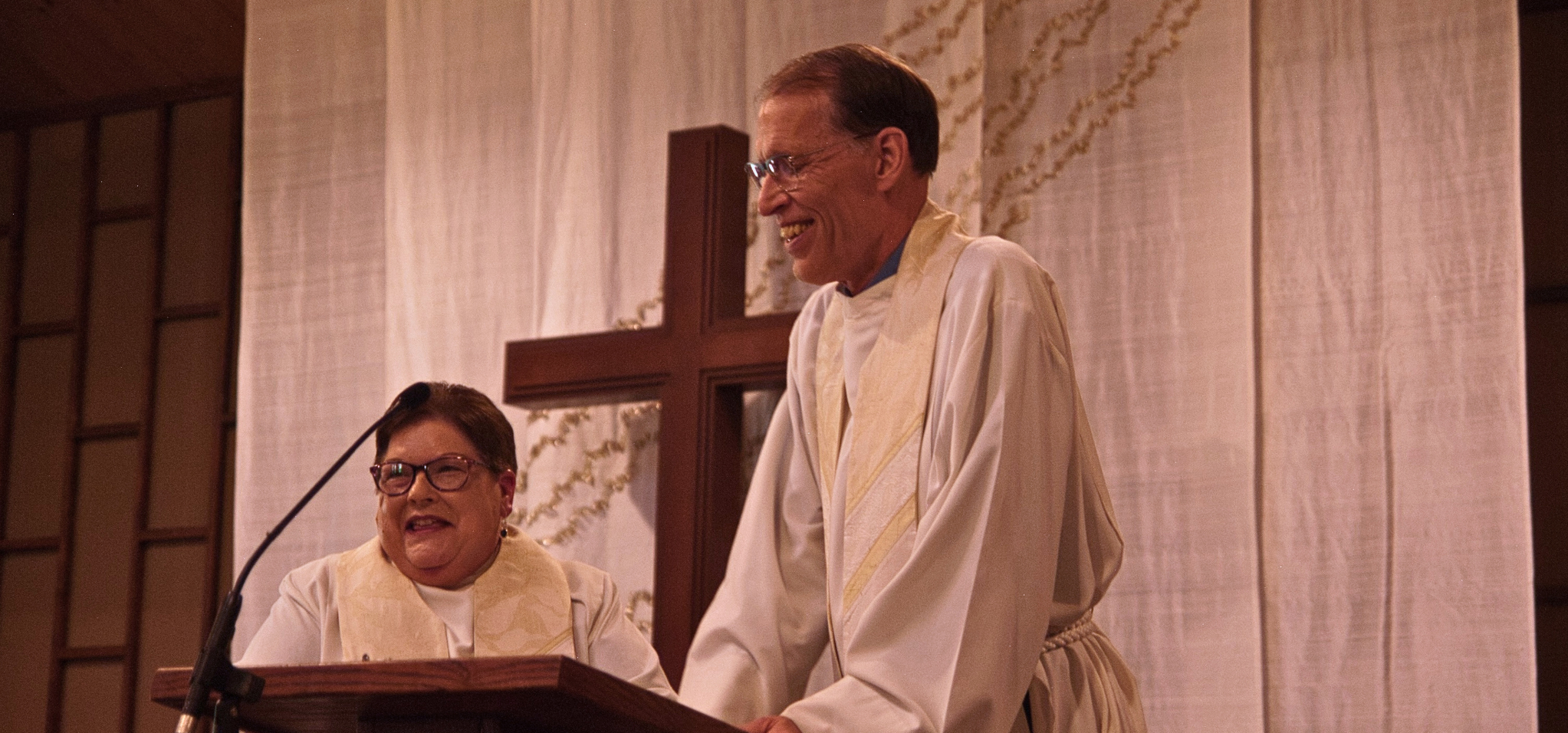
As the Revs. Kevin and Karen Miller retire after 45 years co-leading in churches, and nearly a decade as co-rectors at Church of the Savior in Wheaton, Illinois, they leave behind a legacy of what shared authority looks like in public.
by Andrea Bailey Willits
With a baseball cap perched jauntily on his head, 16-year-old Kevin Miller was preaching from the middle of a circle of truck inner tubes floating down the Potomac River. He was recently saved, “the religious kid,” so was appointed a makeshift chaplain for his Explorer scouting group. He had no idea that one of his listeners would one day become his wife and longtime ministry partner, and together they would demonstrate shared power and equality in front of a watching church.
Karen Kuczynski was part of the scouting group that day, and Kevin’s faith and bold communication style piqued her interest. The two had known each other since middle school band, but as they began to talk on their scouting excursions, Kevin shared the gospel and eventually led Karen to Christ.
“He calls me his first convert and disciple,” she says. “And then we fell in love—me a little faster than him. He wanted to be a single, traveling preacher man.”
The Role of Women in Church
They married expecting a clean division of labor. Kevin would go to seminary; Karen would be the supportive spouse. Things changed when Kevin read Deuteronomy 24:5—a newly married man should not go off to war but stay home with his wife—deferred seminary, and took a job at David C. Cook Publishing in Elgin, Illinois. One year became five. Five years at Cook became 24.5 years at Christianity Today, where he eventually became executive vice president.

Meanwhile, at the local Vineyard church they attended, Karen was discovering something the people around her had known for a long time: She was a strong leader. The pastor told her, “Everywhere I look, your fingerprint is on it.” In two years as a volunteer, she helped grow the congregation from 75 to 250, started a food pantry, a women’s ministry, small groups, and—what she still finds amusing—the men’s ministry. She also earned her LCSW, took a part-time job as a therapist at an evangelical counseling agency, became the supervisor, built the client base from 50 to over 200, and started two Hispanic counseling centers without speaking Spanish.
Underneath all of it, with growing conviction, Karen felt the pull toward the pastorate. At the time, their Vineyard pastor didn’t believe women could be pastors, so the Millers found their way to Church of the Resurrection in Wheaton, where Karen kept leading and pursuing ordination to the diaconate.
Kevin arrived at his convictions about women’s ordination while editing a magazine issue on Christianity in the Civil War. “I realized that the same hermeneutic that led southern churches to combine Christianity and slaveholding was the same one being used in conversations around women’s leadership.” He also started reading about Catherine Booth, co-founder of the Salvation Army. He and Karen adopted an egalitarian stance together, and Karen was ordained a deacon in 2004, with Kevin following 18 months later.
Karen was serving as executive pastor of Resurrection, a 1,000-person congregation, but the newly-formed Diocese of the Upper Midwest was clear: no female priests.
“I told my daughter,” Karen says, “if I die before I become a priest, will you bury me in a chasuble?”
Priestly Ministry
Kevin and Karen stayed for years in what they called “loving unity and healthy tension” with Resurrection’s approach to women priests. Karen became a leadership coach and consultant with her own organization Strengthen Your Leadership, and Kevin encouraged adding more women into Resurrection’s preaching rotation. But Karen’s desire for the priesthood still hadn’t gone away.
Eventually, at a provincial synod in Pittsburgh, the Millers talked to Bishop Todd Hunter, who encouraged them not to give up their dream of serving as priests together. “Two strong descriptors come to mind when I think of the Millers: mature and wise,” Bishop Todd says. “They are icons of steadfast ministry partners.”
Shortly thereafter, the Rev. Bill and Linda Richardson, co-rectors of C4SO’s Church of the Savior in Wheaton, mentioned they were retiring, and asked if the Millers would consider applying to be their replacements.
“We were immediately impressed with their character, obvious care for others and leadership abilities,” Bill says.
Savior was primed for husband-wife co-rectors after the Richardsons’ tenure, and the Millers enthusiastically accepted the call. Karen was ordained a priest three months after they started at Savior, and she and Kevin were installed as co-rectors in the same service.
“We were especially blessed to have Karen be ordained to the priesthood and have them minister together as priests,” Linda says.
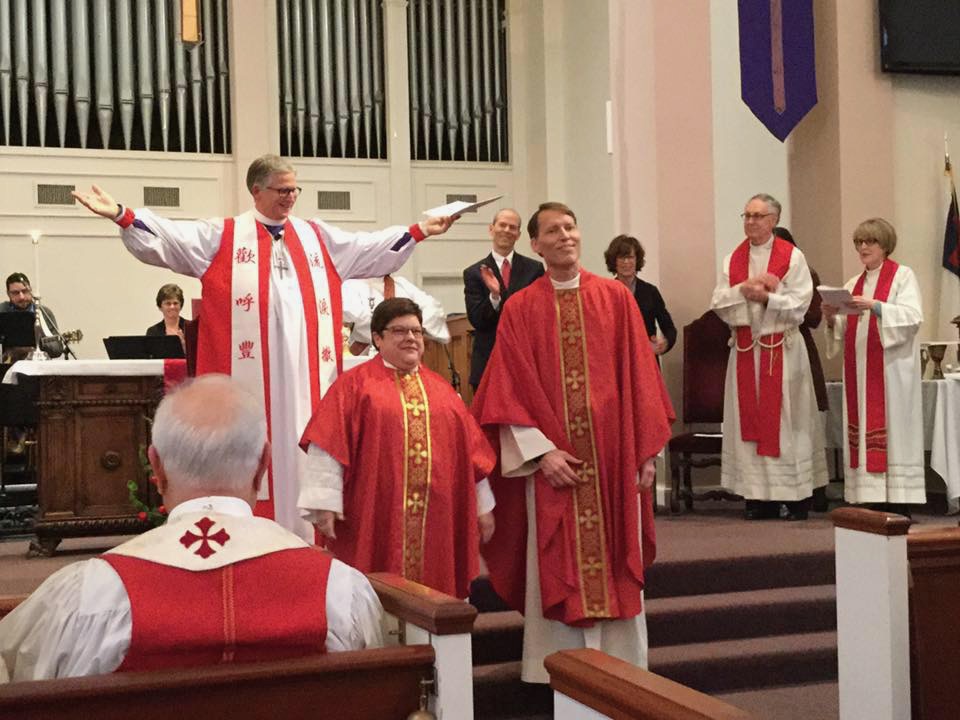
The Millers’ installation as co-rectors at Church of the Savior in 2017, with their precedessors Bill and Linda Richardson on the right.
“Whose Meeting Is It?”
From their early days at Rez to their nine-and-a-half years at Savior, Kevin and Karen’s ministry has been a master class in shared leadership. There were many opportunities for them to explore what they intellectually believed about shared leadership and what they actually felt when the other person’s idea won, got the credit or outperformed theirs—as well as how other people experienced their vigorous (but friendly!) disagreements in staff meetings.
“We have such trust in each other, we can disagree forcefully, but that unnerved the staff. It was like Daddy’s fighting with Mom right here in the kitchen in front of the kids,” Kevin says. “We had to moderate how we argued.”
This led to a discipline they brought with them into every leadership context: Whose meeting is it? Before walking into any significant meeting, they established who owned the room. For instance, Karen ran staff meetings; Kevin led vestry meetings. In each other’s meeting, you had a voice, not a vote.
“When I would go to a staff meeting,” Kevin says, “I went in telling myself: I’m not going to take over this meeting, even though I have a natural proclivity to want to lead any meeting I’m in. This is Karen’s meeting.”
Disciplines for Co-Leading
There were other helpful disciplines throughout the years. They instituted a weekly business meeting for church logistics, so the rest of their time together wasn’t colonized by agenda items. Thursday was a non-negotiable date night: Even if the Pope himself called for dinner on a Thursday, the answer would be no. The Millers added a rule: You can talk about church, you can vent, but no problem-solving.
“The moment you’re problem-solving,” Karen says, “you’re back at work.”
Yet another discipline emerged from a Friday Night Lights episode their daughter made them watch. In it, a high school football coach’s wife came into his office and immediately went into full school-counselor mode; the coach just needed a wife to listen, not a counselor to advise. That was one of the Millers’ familiar predicaments. Now, before any intense conversation, they ask: Who do you want me to be right now? Your spouse? Your associate rector? Your coach?
“Sometimes we just need someone to say: ‘This is hard, and you’re right to feel that way,’” Karen says, “That’s all.”
The Enneagram, discovered later in their ministry, gave them language for what had always been true. Karen is an Eight: direct, confrontational, capable of naming conflict in a room where everyone else is politely pretending it doesn’t exist. Kevin is a Three: achievement-oriented, attuned to public perception, inclined to put polish on difficulty.
“Karen would say something bracingly honest in a meeting,” Kevin says, “and I’d feel the room tense up and want to smooth it over immediately. I had to learn to just let Karen be Karen, and work on my own issue, which is needing to look better than I actually am.”
Karen learned from Kevin’s emotional antenna while Kevin learned to sit with the discomfort of a difficult truth.
The final discipline was a crucial piece of their years at Savior: Name your power. In collaborative leadership, ambiguity always gets filled, and rarely well. The Millers avoided the shadow-government problem that plagues many staff spouses by insisting on explicit job descriptions and defined lanes from the beginning. A spouse who sits in on staff meetings, who talks through every decision with the leader, often holds more power than anyone acknowledges, especially the spouse.
“If the power’s unnamed and undefined, the staff can’t figure out how to relate to it,” Karen says.
Harmonious Leadership
Synthia Cathcart, who served as Savior’s Senior Warden, had a front-row seat to how the Millers managed power. “If you haven’t seen a husband and wife lead together in a healthy way,” she says, “I would hold the Millers as examples of what to look for. Neither jockeys for position or subjugates the other personally or in ministry. They have an equal call of God on their lives—not one more important than the other—and their leadership is one of harmony as they serve together.”
Parishioner Christine Sloat observed the same mutuality at work. “Karen is often the one who calls things out, whether that’s praising Kevin’s diligence in working through the budget, or pausing a service so the congregation can hear what the Holy Spirit is saying. Kevin’s gift of teaching has led the congregation into deeper knowledge of God week after week, as has the silent witness of the way he physically supported Karen by helping her to a stool when she needed to sit down while serving the Eucharist.”
For parishioners, “the stool” proved to be more memorable than the homily each week. Both the Millers suffer from chronic degenerative conditions. Kevin has Parkinson’s; Karen has had eight orthopedic surgeries in nine years.
“Savior has watched me support Karen through her surgeries,” Kevin says, “and she supported me through my diagnosis. And they’ve watched Karen receive help—which, as an Eight, has not come naturally to her. That’s been as much a part of the witness as anything we formally taught.”
The Rev. Dr. Sarah Lindsay, who served under the Millers at Savior for years and has been selected as the church’s next rector, wants to carry into her own ministry the grace and humility to recognize the gifts that others have, and to support those gifts. “Kevin equally supported Karen. She has a strong personality and very evident gifts of leadership, and I never saw him threatened by her strengths. They have a very real partnership in which they both want to see the other thrive.”
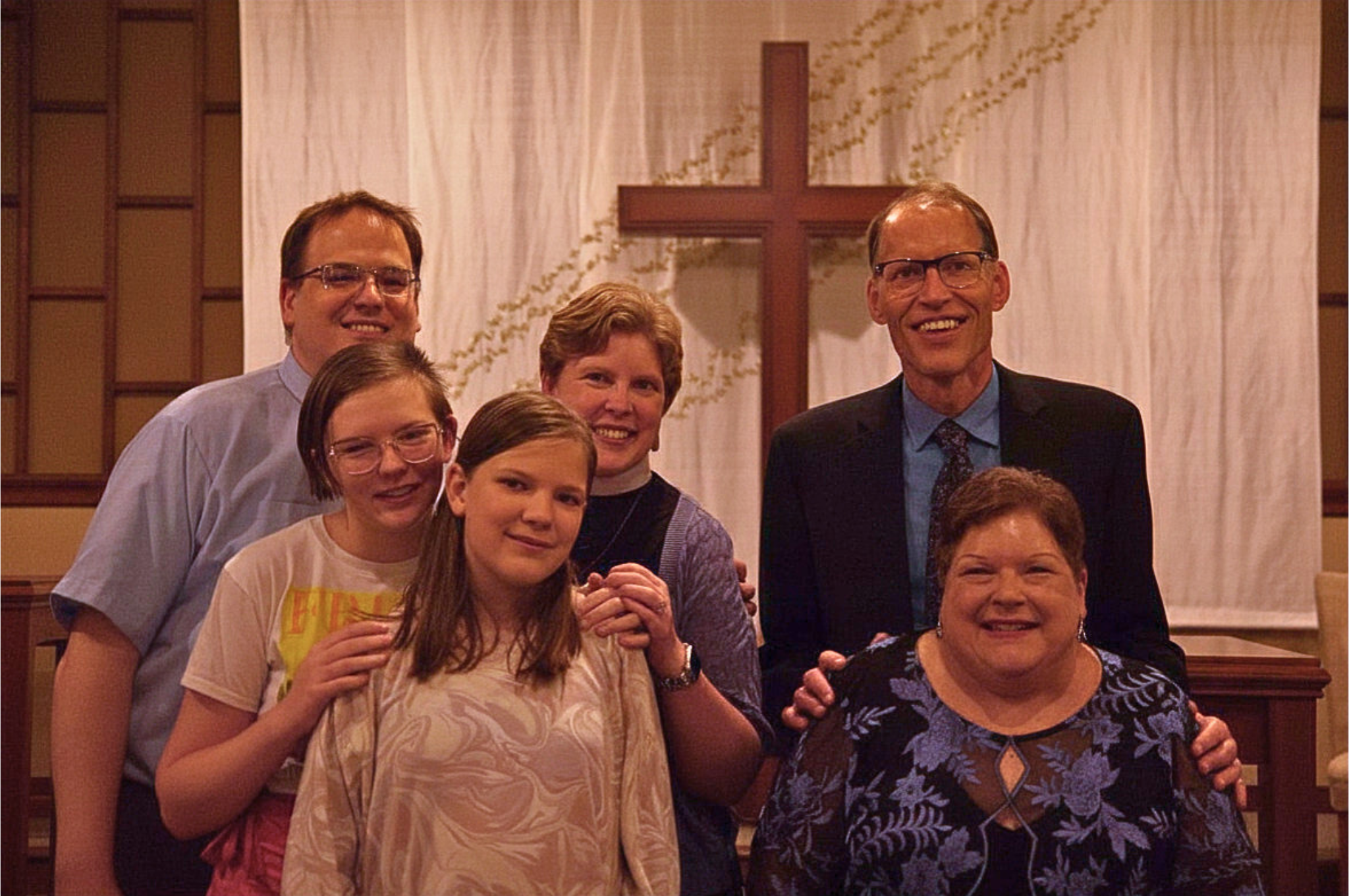
The Revs. Kevin and Karen Miller with the Rev. Dr. Sarah Lindsay—Church of the Savior’s new rector—along with her husband the Rev. Brad Lindsay, and their two daughters
When Kevin officiated at Christine Sloat’s wedding, he preached on a vision of Christian marriage: “The blessings of marriage are for you, but not just for you. A Christian marriage should be like a stone dropped into a pond, where the ripples go out further and further.” That is the vision the Millers have sought to embody throughout their ministry, and hope to continue after retirement.
A New Chapter
May 30, 2026, marked the Millers’ final service at Savior. They handed Sarah the parish register and stoles that match Savior’s banners for Advent and Lent. Then the church held a BBQ dinner with a Western theme, complete with a photo booth where people could dress as cowboys.
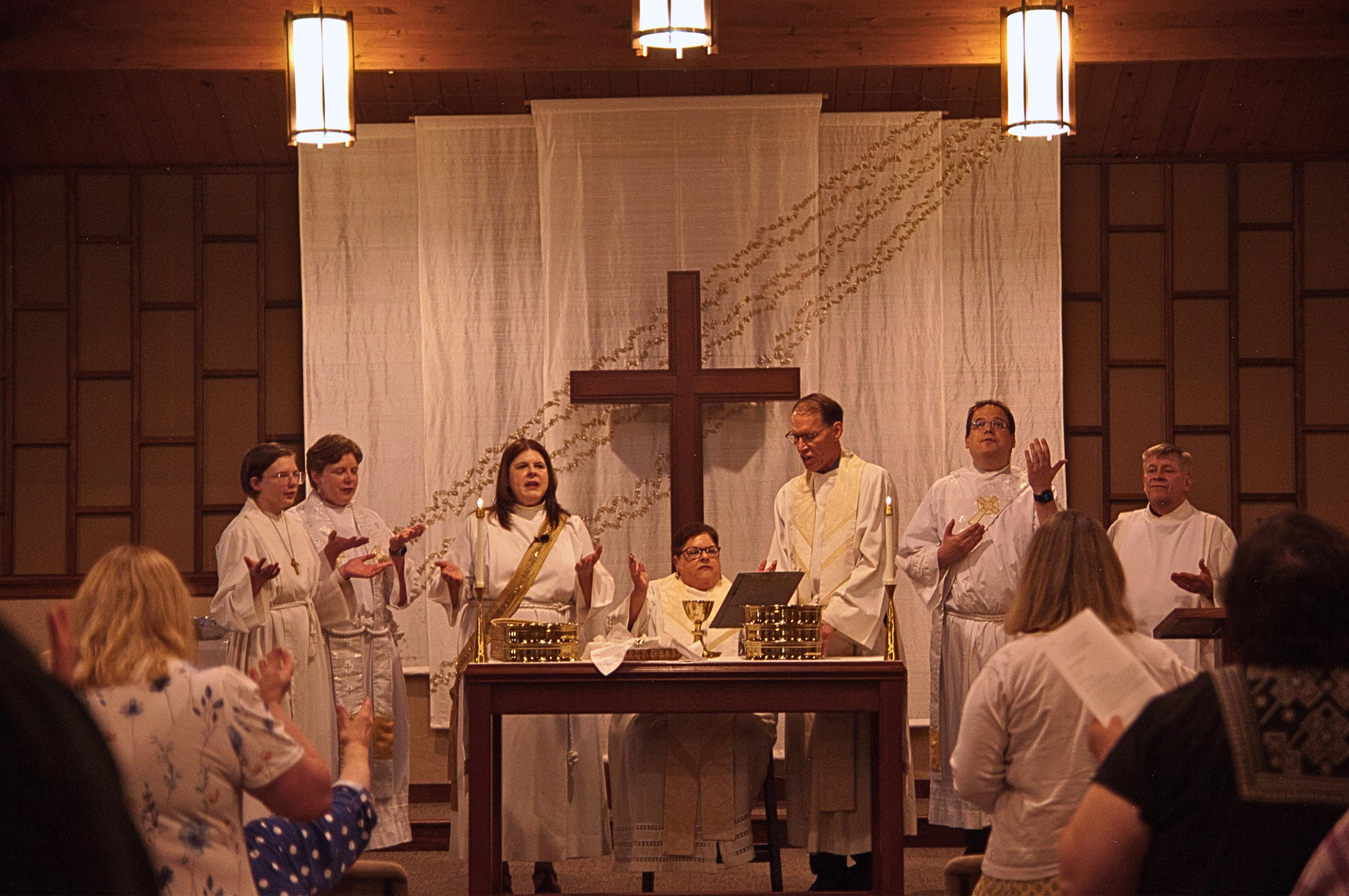
The Revs. Kevin and Karen Miller celebrate the Eucharist at their final service at Church of the Savior.
Kevin and Karen recently relocated to Naperville, Illinois, to be near their daughter, son-in-law and granddaughter. The future includes tending friendships, attending to their health, and continuing to resource younger leaders: Karen through her coaching practice, Kevin through writing and sermon coaching.
They leave behind a church that knows by long observation what it looks like when two people genuinely share the room.
Parishioner Nadine Rorem says that above all, the co-rectors demonstrated the humble and servant love of Christ for the Church.
“There is mutual support and a clear picture of a spiritual mother and father who care deeply for the church,” she says. “The Millers support the development of one another’s gifts and growth. They do not compete, but complement each other in a way that invites you to do the same in your own relationships.”